

Introduction
Agricultural gearboxes specifically designed for tractors are core components of agricultural mechanization. Their selection directly affects operational efficiency, the stability of power transmission, and the overall lifespan of the machine. This article unfolds from four aspects: technical principles, scene adaptation, selection parameters, and matching techniques. By integrating industry practice with the latest technologies, it provides a systematic guide for agricultural machinery practitioners.
Technical Principles and Classification
Power Shift Gearbox
Power shifting is achieved through a wet multi-plate clutch under load conditions without interruption. Its core advantage lies in simplifying the operation process and enhancing the continuity of work. For instance, a certain model of transmission, through the coordinated operation of dual clutches, has achieved a power transmission overlap rate of 85% and reduced gear shifting shock by 60%. Its typical application scenarios include deep loosening, sowing and other field operations that require frequent speed changes.
Hydraulic Mechanical Continuously Variable Transmission (HMCVT)
HMCVT combines hydraulic transmission with mechanical differential to achieve continuous adjustable output speed. Take the Fendt Vario system as an example. Through the coordination of the planetary gear set and the variable pump-motor, it maintains a constant torque output within the range of 0.02-50km/h, and the fuel efficiency is 15% higher than that of the traditional transmission. This technology is particularly suitable for scenarios such as orchards and tea gardens that require precise speed control.
Mechanical stepped transmission
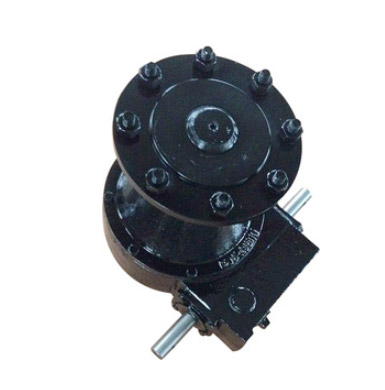
The universal micro agricultural machinery transmission adopts a four-axis transmission structure, and the axial sliding gear shifting is achieved through the fork shaft lever. Its sealing design adopts a combination of formed felt rings and double-lip sealing rings, with a water and oil leakage rate of less than 0.5% and a service life of over 5,000 hours. It is suitable for low-load scenarios such as small-scale plowing and weeding.

Core Parameters for Selection
Power Matching
- Field operations: Models with a power of 65kW (88 horsepower) or above are recommended, such as hybrid electric drive gearboxes, which can be adapted to deep loosening machinery.
- Orchard scene: Select a 50kW pure electric model, with a turning radius of no more than 4.5m, such as a dedicated gearbox for greenhouses.
- Hilly and mountainous areas: Priority is given to the extended-range short wheelbase design, and the climbing ability should be ≥22°.
The rotational speed is compatible with the splines
- The speed of the power output shaft: It needs to be matched with the input shaft of the machine tool. Common specifications are 540r/min, 720r/min, and 1000r/min. For instance, the EP-75 rotary tiller gearbox requires an input speed of 540r/min and an output torque of 539Nm.
- The number of spline teeth: 8-tooth rectangular splines are the general standard, while 21-tooth involute splines are suitable for high-torque scenarios. It is necessary to ensure that the spline specifications of the machinery and the transmission are consistent.
Sealing and Protection grade
- Dust-proof design: Equipped with an IP67 protection grade sealing ring, it can resist the invasion of particles with a diameter of ≥1mm, extending the service life of the transmission by 30%.
- Waterproof performance: The double-lip sealing ring with reverse installation structure can withstand immersion in water up to 1 meter deep for 2 hours without leakage.

Scenario-based Matching Techniques
Field Operation Matching
Equipment combination: The suspended seeder should be equipped with a rear three-point suspension device. The horizontal instant center of the lower pull rod should be located within 100mm in front of the center of the rear wheel to ensure the vertical transmission of the traction force.
Power distribution: The transfer case design is adopted. For instance, a certain model drives the wheels on both sides through a hydraulic motor to achieve differential steering, reducing the turning radius by 40%.
Orchard Operation Optimization
Space adaptation: Select a side suspension transmission. The body width should be ≤1.5m. For example, the Lovol Oubao M704-EF (with a width of 1.2m) can pass through orchards with a standard row spacing of 1.8m.
Low-speed stability: The torque fluctuation rate of the HMCVT transmission is ≤3% at speeds below 5km/h, making it suitable for precise trimming operations.
Responses to Hilly and Mountainous Areas
Anti-overturning design: It adopts a dual hydraulic cylinder balancing system. For instance, when a certain model operates on a 15° slope, the body tilt Angle is automatically compensated to no more than 5°.
Rock terrain mode: The ground hardness is detected by sensors, and the automatic lifting equipment is lifted by 15cm to avoid impact from hard objects.


Guide to Avoiding Pitfalls in Selection
Problem of false power marking
Be cautious of some manufacturers marking “maximum power” instead of “12-hour rated power”. In actual operation, a 20% power margin should be reserved. For instance, when a 70kW model undergoes continuous deep loosening operations, its measured power drops by 15%. Therefore, a model with a power of 75kW or above should be selected.
Compatibility Risk
Universal drive shaft: The length should be 50-100mm shorter than the distance between the machine tool and the gearbox to prevent the square shaft sleeve from coming out. When in operation, the Angle should be ≤10°; otherwise, the transmission efficiency will decrease by 25%.
Electronic control interface: For new energy models, it is necessary to confirm the compatibility of the CAN bus protocol.
Maintenance Cost Trap
Seal replacement: Although the cost of double-lip seals is 30% higher than that of single-lip ones, their lifespan is extended by two times and the overall maintenance cost is reduced by 40%.
Lubricating oil selection: Synthetic gear oil can extend the oil change cycle to 1000 hours, but the initial cost increases by 50%. It needs to be balanced based on the intensity of the operation.


Industry Trends and Policy Support
Intelligentization: The Beidou navigation system combined with electro-hydraulic control technology ensures a straight-line driving accuracy of ±2.5cm and a night operation error of less than 5cm.
Electrification: The torque response of permanent magnet synchronous motors has been increased by 40%, the commutation time has been shortened to 0.8 seconds, and the overall cost is reduced by 80% compared with fuel engines.
Conclusion
When selecting a dedicated agricultural gearbox for tractors, it is necessary to comprehensively consider core parameters such as power, rotational speed, and sealing performance, and match them in combination with the characteristics of scenarios such as large fields, orchards, and mountains. It is recommended to give priority to the models that have passed the test and appraisal of the Ministry of Agriculture, and at the same time pay attention to the efficiency improvement and cost optimization space brought by new energy technologies. In the future, with the in-depth application of modular design and intelligent algorithms, agricultural gearboxes will evolve towards greater efficiency and better adaptability.